
Key Takeaways
- Google now ranks structured topical authority systems, not isolated keyword pages.
- AI Overviews reduce clicks for shallow informational content and reward deeper, decision-ready pages.
- Backlinks alone no longer compensate for weak content or poor architecture.
- Topical clustering and entity clarity drive stronger long-term rankings.
- Search intent alignment is more important than traffic volume.
- Technical SEO and AI optimization are foundational, not optional.
- If your SEO is declining in 2026, the issue is likely systemic rather than page-level.ing, it is rarely because you “did nothing.” It is usually because Google changed what it values, and your strategy did not.
Why SEO Feels Different in 2026
Search engine optimization in 2026 looks completely different from past years.
Traffic dips slowly. Rankings fluctuate unpredictably. Pages that once performed steadily disappear from visibility without warning. Meanwhile, competitors with fewer backlinks and less content begin outranking you.
If your SEO is not working, it is rarely because you “did nothing.” It is usually because Google changed what it values, and your strategy did not.
To understand why SEO struggles today, you need to understand what Google is optimizing for now.
Google Is Ranking Systems, Not Pages
Over the last several years, Google’s algorithm has shifted from page-based evaluation to entity-based evaluation.
Core updates throughout 2023 and 2024 integrated Helpful Content signals permanently into Google’s ranking systems. That means usefulness, clarity, and topical authority are no longer bonuses — they are foundational.
Google’s documentation on Helpful Content makes this explicit. The system rewards content created “for people, not search engines.”
This shift has three implications:
- Individual pages no longer rank in isolation
- Domain-level authority matters more
- Topical depth outweighs keyword targeting
If your SEO strategy is still publishing disconnected keyword articles, performance will stall.
AI Overviews Changed Click Behavior
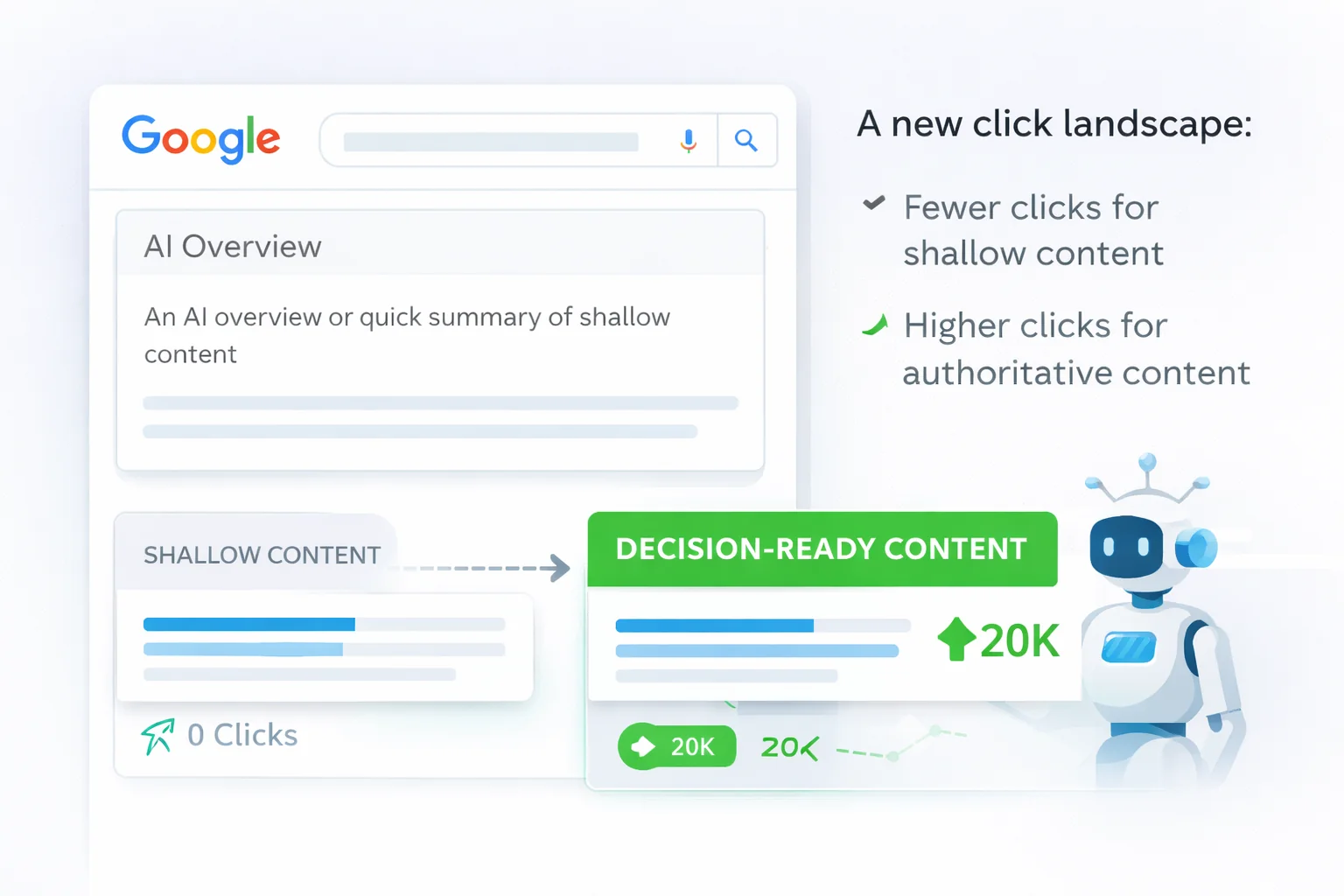
In 2024, Google rolled out AI Overviews to U.S. search results. These AI-generated summaries now appear at the top of many informational queries.
This has changed user behavior in two major ways:
- Fewer clicks for shallow informational content
- Higher clicks for authoritative, structured, decision-ready content
When Google can summarize your blog in the results page, your page must provide deeper value than the overview itself.
That is where AI-structured SEO becomes critical. Pages need clear semantic architecture, entity reinforcement, and answer clarity that makes them usable both by AI systems and by humans.
If your content was built only around keywords and not structured intent, it will struggle.
Modern SEO requires deeper technical alignment. Check out our approach to AI SEO.
Backlinks Alone No Longer Carry Weak Content
Backlinks still matter. Authority still matters.
But Google’s spam and core updates over the past two years have reduced the ability of backlinks alone to prop up mediocre content.
Post-core-update winners tend to show stronger topical clustering and clearer site architecture rather than simply larger backlink profiles.
In other words:
Content quality is weighted more heavily
Internal linking structure matters more
Entity clarity improves trust signals
If your SEO investment focused heavily on link building without reinforcing topical depth, rankings will erode over time.
Topical Authority Is the New Ranking Currency
Google wants to understand what your site is about, not just what individual pages target.
Topical authority means:
Covering a subject comprehensively
Structuring content into clusters
Reinforcing entity relationships
Demonstrating experience and credibility
Google’s E-E-A-T framework emphasizes experience, expertise, authority, and trustworthiness as quality indicators.
Websites that publish scattered blog posts across unrelated categories rarely perform well in 2026. Websites that build focused topic ecosystems do.
This is why structured SEO strategies outperform ad hoc content production.
Traffic Without Revenue Signals Weak Intent Alignment
Another reason SEO “is not working” is not ranking loss it is revenue misalignment.
Many websites still chase informational keywords with low commercial intent. They attract traffic but generate no pipeline.
In 2026, SEO success depends on:
Aligning keyword targeting with buyer stages
Designing landing pages for conversion
Structuring content around decision support
Reinforcing commercial signals clearly
Search intent matters more than ever. Informational visibility without transactional pathways will not produce growth.
That is where SEO and CRO intersect.
Technical SEO Is Quietly More Important
AI-driven search systems rely heavily on structured data, clean architecture, and crawl efficiency.
If your site suffers from:
Poor internal linking
Duplicate or thin content
Slow performance
Index bloat
Inconsistent schema
Google’s systems will struggle to trust and rank your content consistently. Technical SEO is no longer a backend hygiene task. It is foundational to AI visibility.
So Why Is Your SEO Not Working?
Because the rules changed.
SEO in 2026 rewards structure, depth, and clarity. Google now prioritizes sites that build comprehensive topical ecosystems instead of publishing isolated keyword posts. It values entity clarity over volume, intent alignment over traffic quantity, and experience-backed content over surface-level summaries. Clean technical infrastructure and AI-optimized formatting are no longer advanced tactics. They are baseline requirements.
At the same time, Google increasingly suppresses disconnected blog publishing, keyword stuffing, thin informational pages, and backlink-heavy strategies that lack substance. The algorithm is no longer impressed by volume. It evaluates coherence.
Final Thoughts: SEO in 2026 Requires a System
SEO is no longer about producing more content or chasing rankings. It is about building a structured authority system that aligns technical architecture, topical depth, AI visibility, and conversion intent.
If your traffic is inconsistent or your growth has plateaued, the issue is rarely a single page. It is almost always a fragmented strategy.
At Jives Media, we build performance-driven organic systems designed for how Google actually ranks today. Our structured SEO services focus on technical infrastructure, topical authority modeling, and revenue-aligned content strategy, while our advanced AI SEO frameworks ensure visibility across AI Overviews and entity-based search.
If your organic growth feels unpredictable, it may be time for a system-level reset rather than another tactical tweak. You can request a strategic evaluation directly through our contact page to see where your current SEO approach is breaking down.